September 14, 2026 · 7 min
Above ground oil tank inspection: what a full examination actually covers
A full aboveground oil tank examination from foundation to roof, in the order an inspector walks it, and what each part of it is trying to find.
Above ground oil tank inspection is the work this site describes most exactly, and it is the one of the three oil tank jobs that is genuinely ours. Many of the people asking want to understand the examination before they buy one. Good. Here is what a full examination of an aboveground oil tank covers, and why each piece is there.
First, which standard governs
A welded tank erected in the field is examined under API 653 and its three examinations. A shop-fabricated tank that arrived complete is examined under STI SP001, where the assigned category decides everything. The split decides which examinations are owed, how the intervals are derived and who signs, so it is the first question answered, from the nameplate and the drawings, before anything is scheduled.
For an oil tank there is usually a second layer: a facility storing oil above the applicability thresholds in the federal regulation may need an SPCC plan, and that plan generally requires integrity testing in accordance with industry standards. In practice it points back at API 653 or SP001 rather than inventing a rival regime, but whether it applies at all is a question about the facility, answered per site, alongside everything else in the four sources that set tank requirements. Tanks in fuel service can pick up further layers again, from fire codes to emergency-power rules, and a later article in this series takes up that situation on its own.
The foundation and the ground the tank sits on
Ringwall condition, grout, drainage, and whether water stands against the chime, which attacks the most consequential weld on the tank from the outside. Settlement is measured rather than eyeballed, because differential settlement loads the shell and bottom in ways neither was designed for, and a survey turns that worry into a number.
Shell and roof, walked and measured
Coating condition, corrosion, distortion, weld seams, nozzles and manways, then ultrasonic thickness readings on a grid that follows the shell courses. On the roof: plate condition, seams, vents and gauge hatches, and ponded water, which thins the plate where it sits. The external examination as a whole is described on external tank inspection, and access, more than anything else, decides what it costs.
What the walk is really hunting is the pattern rather than the blemish: coating blistering that spreads from a seam, staining that recurs at the same nozzle, a low spot on the roof that has grown since the last photographs. A single defect is a repair. A pattern is a mechanism, and mechanisms set the agenda for the internal work.
The bottom, which is the point
An oil tank’s bottom corrodes from above, where water settles under the product, and from below, against the foundation, where nothing can be seen from anywhere. That is why the internal examination exists: tank emptied, cleaned, gas-freed and entered, bottom plates measured on a grid, pits gauged, the shell-to-bottom weld examined, and the underside condition evaluated. What entry involves is set out on internal tank inspection.
The calculations behind the dates
Readings on their own are not a conclusion. The examination produces a corrosion rate against previous readings, a remaining thickness against a calculated minimum, and from those a next due date that can be defended when a regulator or an insurer asks how it was derived. A tank with no measured history gets conservative answers, because nothing has been established; the mechanics of that derivation are on integrity assessment.
What else rides on the same visit
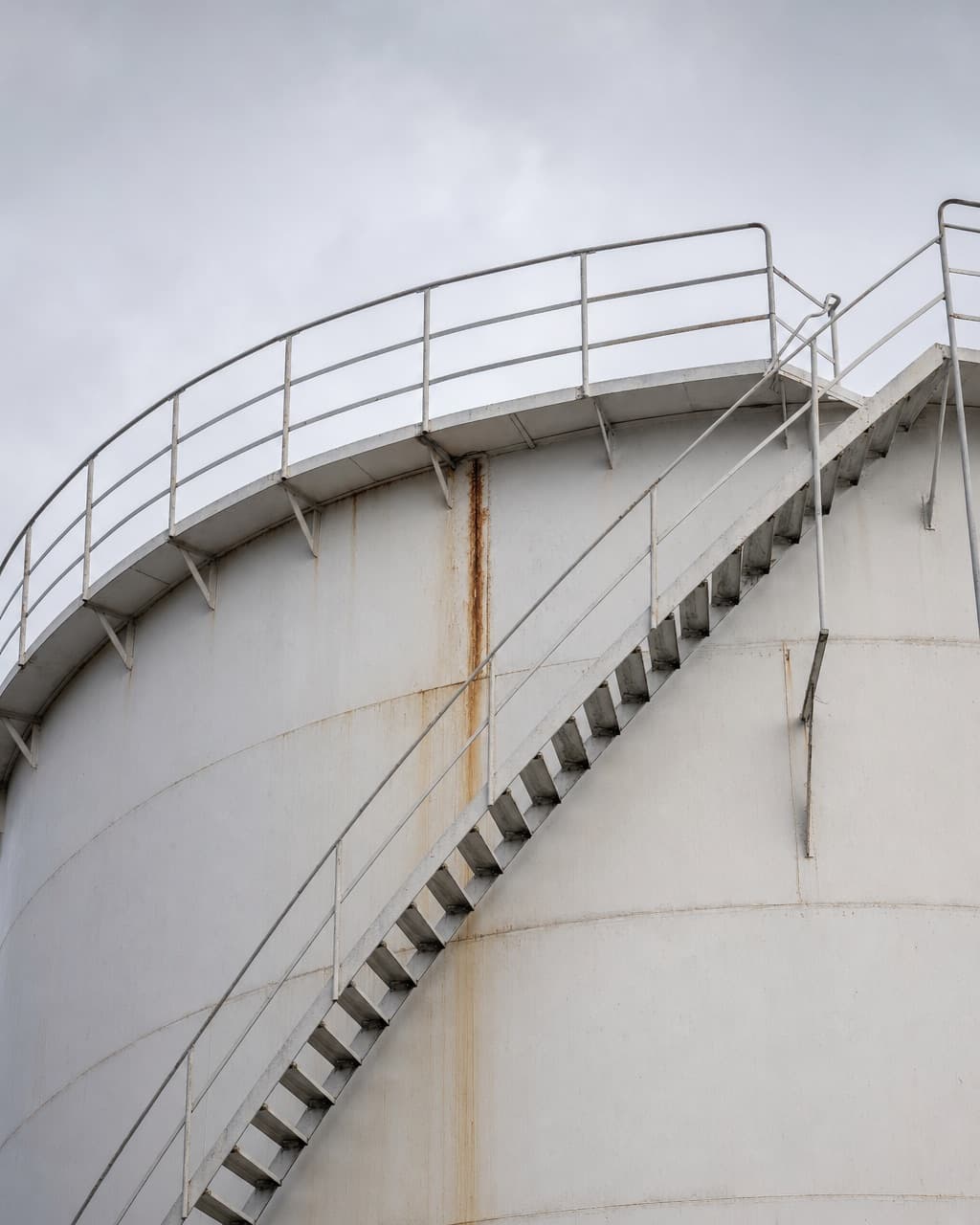
Appurtenances that somebody climbs or that the product passes through: stairways, platforms, handrails, grounding, valves and flanges, and the containment around the tank. None of it is the headline, and any of it can be the finding that matters this year.
Containment deserves its own sentence. A dike holding rainwater with a closed drain valve, a cracked wall, or a floor that no longer slopes to the sump are findings in their own right, among the cheapest on the whole list to fix, and they are the ones a regulator sees from the gate.
What to have ready before anyone mobilizes
The drawings, the nameplate data, previous reports and thickness readings, the repair and product history. The examination is cheap or expensive largely on the strength of that file and of the access, scaffolding being the single largest variable, as set out on what drives the cost. A scope written against the file beats a scope discovered on site, every time, and it is the difference between an examination that answers your questions and one that merely happened.
Have the examination scoped against your tank's file
Drawings, prior readings and access decide the scope. Confirm all three before accepting any quote.
Steel Tank Inspection is an independent reference on aboveground storage tank inspection under API 653 and STI SP001. It performs no inspections and signs no reports. It explains what an examination covers, what a compliant report has to contain, and how to verify that the inspector you are about to hire is currently certified.