November 11, 2026 · 4 min
Cargo tank inspection: the DOT tests a tank truck carries on its shell
A tank that moves hazardous materials by road is inspected under federal transport rules, not storage tank standards. The tests, the marks and the paperwork follow it from one terminal to the next.
A fuel distributor, a chemical carrier or a farm cooperative often owns two kinds of steel tank: the ones that stay on a foundation and the ones that travel on a chassis. The first answer to storage tank standards, fire codes and state programs. The second answer to the Department of Transportation, and the people who inspect them, the tests they run and the records they leave behind are different. Mixing the two up is how a fleet ends up with a truck that is out of test without anyone noticing.
What counts as a cargo tank
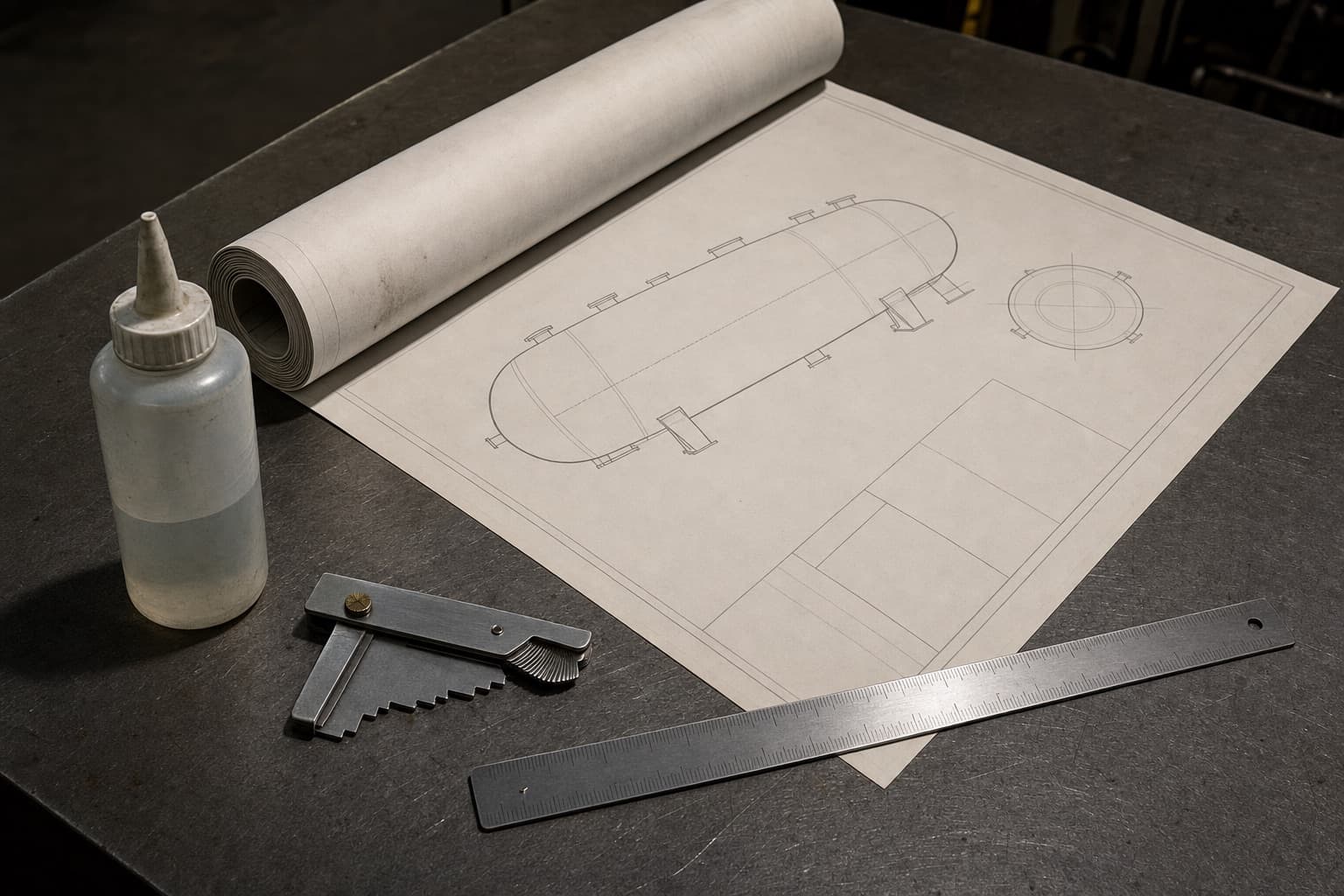
In the federal hazardous materials regulations, a cargo tank is a bulk packaging permanently attached to a motor vehicle, or forming part of it, and loaded or unloaded without being removed. Gasoline and diesel tank trucks, chemical trailers, propane bobtails and transports, and cryogenic trailers all fall in the category. Most are built to a DOT specification named on the specification plate: DOT 406 for petroleum products at low pressure, DOT 407 and DOT 412 for chemicals and corrosives, MC 331 for compressed gases such as propane, MC 338 for cryogenic liquids. Older tanks may carry the earlier MC 306, MC 307 and MC 312 designations.
Where the inspection requirements are written
The rules for keeping a cargo tank in service are in 49 CFR part 180, subpart E, on the qualification and maintenance of cargo tanks. They list the periodic tests and inspections, the specifications each one applies to, the intervals, the acceptance criteria and the records. Intervals vary with the specification and the service, so the table in the current text, applied to the tank on its own plate, is the reference. A summary found online is a starting point at best.
The tests in the cycle
Depending on the specification and the lading, the cycle combines an external visual inspection, an internal visual inspection, a leakage test, a pressure test, thickness testing on tanks prone to corrosion or wear, an inspection of the lining on lined tanks, and on some trailers an inspection of the upper coupler that carries the load onto the tractor. The visual inspections look for corrosion, dents, cracks, weld defects, damaged valves and manhole covers, and the condition of emergency discharge controls. A tank that fails any of them is not returned to hazardous materials service until it has been repaired and has passed the required tests again.
The marks on the tank
After each test or inspection, the rule requires the date and the type to be marked on the tank, near the specification plate, in a format the rule specifies. A driver, a terminal or a roadside enforcement officer reads those marks to judge at a glance whether the tank is in test. The logic is close to the date stamped on a portable cylinder, described in reading the marks on a cylinder collar, except that a cargo tank carries several dates at once, one for each kind of test.
Who performs the tests
Cargo tank tests and inspections are performed by people who meet the qualifications set in the rule, working for facilities registered with the Department of Transportation for that work. Repairs to the tank itself are subject to their own conditions, and on code tanks they bring in the requirements of the construction code as well. The credential to ask for is the one the cargo tank rule recognizes. An API 653 certification, central for field erected storage tanks, says nothing about qualification for a tank truck, and the reverse holds too. The broader sorting of which tank answers to which rule is in who inspects what.
The paperwork that travels with the tank
Each test produces a written report with the items the rule lists, and the owner keeps it for the period the rule sets, together with the certificate and the manufacturer’s data report where they exist. When a tank is sold, the file should change hands with it. A tank whose test history has been lost is a tank that has to be tested again before anyone can vouch for it.
When a tank stops moving
A trailer parked behind a terminal and used as fixed storage, or a skid tank lifted off a truck, raises a different question. Once a tank stores product on site instead of carrying it, the requirements for stationary storage start to matter, including spill prevention planning where the facility falls under it. The requirements that apply to a tank on the ground are assembled in aboveground storage tank inspection requirements. Keeping one list of every tank, mobile or fixed, with the rule each one answers to, is the simplest way to stop either kind from going out of date.
Tanks on the road and tanks on the ground?
Describe the fleet, the stationary tanks and what is coming due. Four questions, then a call.
Free and with no obligation: we call you back to confirm the details, then, with your OK, your request goes to one certified inspector who covers your area and follows up with a quote.