August 10, 2026 · 6 min
Aboveground tank inspection: what triggers each level of examination
Nothing about a tank makes an inspection urgent except evidence. Here is the evidence that moves a tank up the list, in the order it usually appears.
Owners with several tanks and a finite budget have to decide which one to inspect first. The interval tells you when an inspection is due. Evidence tells you which one to move forward, and the evidence is nearly always visible from the ground, which is what the routine operator walk exists to collect.
Water where water should not be
Standing water against the chime, at the shell-to-bottom weld, is the single most consequential thing you can see on a walk around a tank farm. It corrodes the most important weld on the tank from the outside, and it is caused by something cheap to fix: blocked drainage, a settled ringwall, a graded surface that has stopped draining away.
Ponded water on the roof is the same failure with a different consequence: it thins the roof plate where it sits, and the low spot gets lower.
Coating failure spreading from a seam
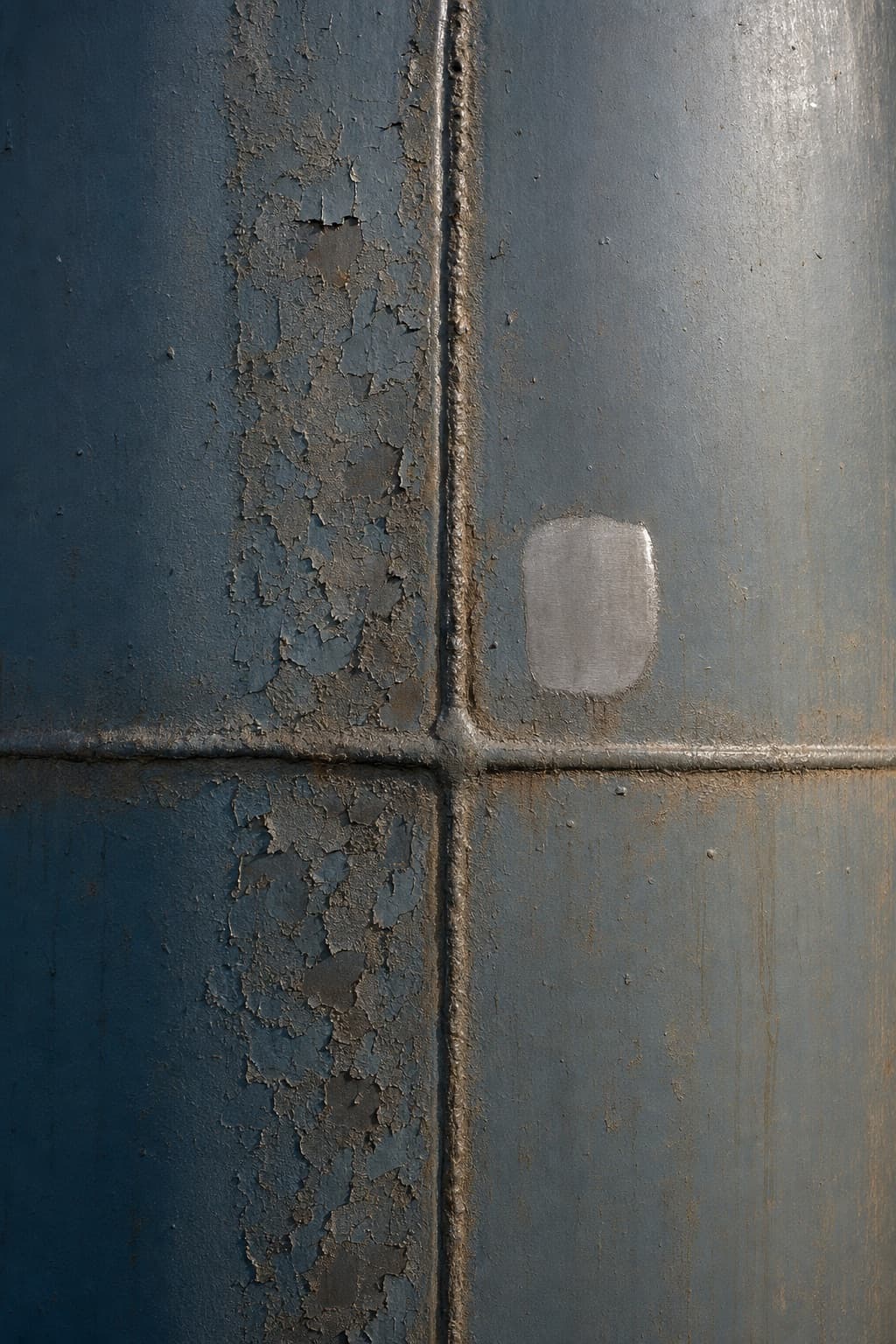
Coating fails at edges and welds first, because that is where it is thinnest and where the steel profile is most awkward. Blistering that is spreading from a weld seam is worth moving forward for, because the corrosion under a lifted coating is not visible and is frequently worse than the surface suggests. What is happening under it is covered under corrosion and NDT.
Any change in shape
Tanks are supposed to be round and level. A shell that has gone out of round, a roof that has dished, a stairway whose treads have stopped being level, a crack in the ringwall grout on one side only: all of these say the foundation has moved. Differential settlement is the finding with the widest consequences, because it loads the shell and the bottom in ways neither was designed for.
It is also measurable, cheaply, with a survey. A settlement survey is the least expensive way to turn a worry into a number.
A change of service
A tank that has held one product for twenty years and is about to hold another is a different tank from a corrosion point of view. Changing service before establishing the current condition means the next inspection cannot separate what the old product did from what the new one is doing.
An absence of records
Not a finding on the tank, but the reason a tank should move up the list. With no thickness history, every interval has to be set conservatively and every future decision is made without a trend, which is why an inspection starts in the filing cabinet. The first inspection on an undocumented tank is the one that makes the following twenty years cheaper.
What none of this replaces
The intervals in the standard as adopted at your site. Evidence changes the order of the list; it does not extend a due date. Which intervals apply, and whether a state program modifies them, is confirmed per site as part of planning the inspection.
Have the tank looked at before the finding chooses the date
An external examination is a day. A discovered leak is a shutdown on somebody else's schedule.
Steel Tank Inspection carries out API 653 and STI SP001 inspections on welded steel storage tanks: external and internal examinations, ultrasonic thickness readings, bottom evaluation, and the report the standard requires.