September 24, 2026 · 7 min
API 650: what the construction standard decides, and why it still governs a forty-year-old tank
API 650 builds tanks and API 653 keeps them in service. The first one sets the numbers the second one measures against, which is why the original file matters decades later.
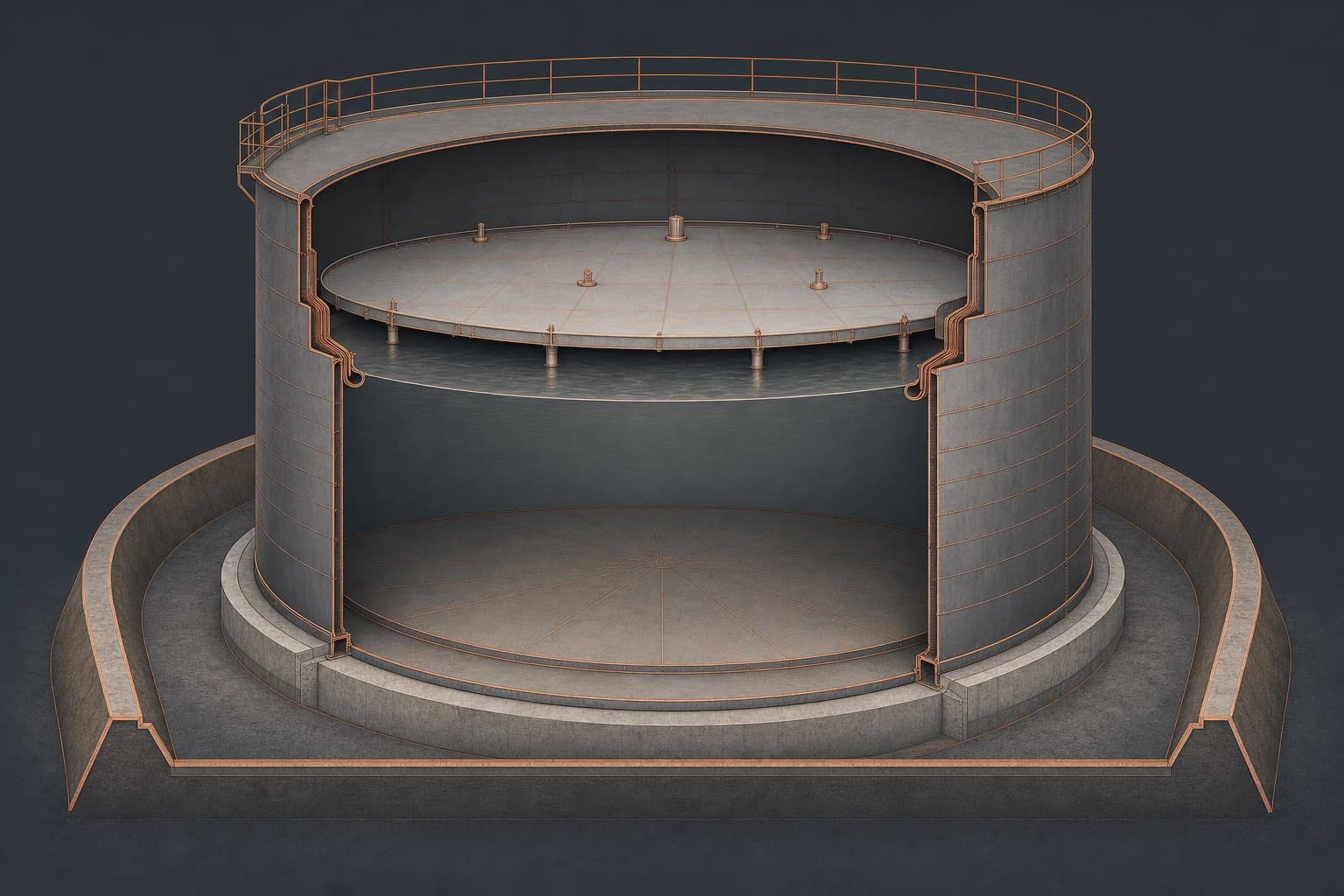
API 650 is the standard for welded steel tanks for oil storage. It governs design and construction: how the shell courses are sized, how the bottom and annular plates are laid out, what the welds have to be, how the roof is built and what the nameplate has to say when the tank is handed over. It is a build standard, and it stops at handover. Everything after that belongs to API 653, which is the in-service standard.
Why a build standard still matters forty years later
Because API 653 evaluates a tank against what it was built to be. A remaining thickness means nothing on its own: it is judged against a minimum derived from the original design, the specified material, the diameter and the height of product the shell has to hold. Lose the construction file and the inspector has to reconstruct those inputs conservatively, which costs money and generally shortens the interval.
What the nameplate carries
The nameplate is the shortest version of the construction file: the standard and edition built to, the year, the fabricator, the diameter and height, the design specific gravity and the shell material. Owners walk past it for years. It is the first thing worth photographing when a tank changes hands, because it is the one record that cannot be recreated from the steel itself. Where the nameplate has gone missing, painted over or been lost in a re-coating, the information has to be rebuilt from drawings, purchase records or measurement, and every gap in that reconstruction is normally closed on the conservative side. That conservatism is not pessimism on the inspector’s part. It is the only defensible position when the design basis is unknown, and the owner pays for it in shorter intervals.
API 650, API 620 and shop-built tanks
API 620 covers large, low-pressure tanks operating above the atmospheric range that API 650 assumes, which is a different design problem rather than a bigger one. Neither applies to shop-fabricated tanks delivered on a truck: those fall under STI SP001 and its category system, and confusing the two is the most common reason an inspection scope is written against the wrong document.
Design specific gravity, the line that traps people
A tank designed for one product is not automatically fit for a denser one. The shell thickness was calculated for a specified specific gravity, and changing service can change the required minimum thickness without anyone touching the steel. Product changes are one of the few events that should trigger an engineering review rather than wait for the next scheduled examination. The same logic applies to fill height. Raising the operating level of a tank increases the hydrostatic head on the lower courses, and a shell that was comfortable at the old level may not be at the new one. Neither change is visible on a walk around the tank, which is exactly why both belong in the records rather than in somebody’s recollection of what the site used to run.
Repairs, alterations and reconstruction
When a tank is repaired or altered in service, the work is carried out under API 653, but the acceptance criteria frequently point back at API 650 for materials, welding and testing. That is the practical relationship between the two documents: one says what good looks like, the other says how often you check and what to do when it is no longer good.
Does API 650 certify anyone
No. There is no individual API 650 certification in the sense people mean when they search for it. Certification for in-service inspection is an API 653 inspector credential, and it is verifiable, which is the subject of the page on checking a certification. A fabricator can hold a licence to apply the API monogram to tanks it builds, which is a company authorization and a different thing entirely.
What to pull together before any scope is written
The nameplate photograph, the original drawings if they exist, the material and design basis, the service history including every product the tank has held, previous inspection reports and thickness data, and the record of any repair. That package is what turns a generic quotation into a scoped one, and assembling it is the cheapest preparation an owner can do.
Find the original construction file
Tell us what records exist for the tank. Four questions, then a call with the drawings open.
Steel Tank Inspection is an independent reference on aboveground storage tank inspection under API 653 and STI SP001. It performs no inspections and signs no reports. It explains what an examination covers, what a compliant report has to contain, and how to verify that the inspector you are about to hire is currently certified.